












The rise of artificial intelligence is rapidly reshaping education, as seen in Rockhurst High School’s classrooms, changing how students learn, complete assignments and how teachers structure their lessons. The Rockhurst administration has been thinking about the future of learning, with AI becoming a predominant tool used by both teachers and students.
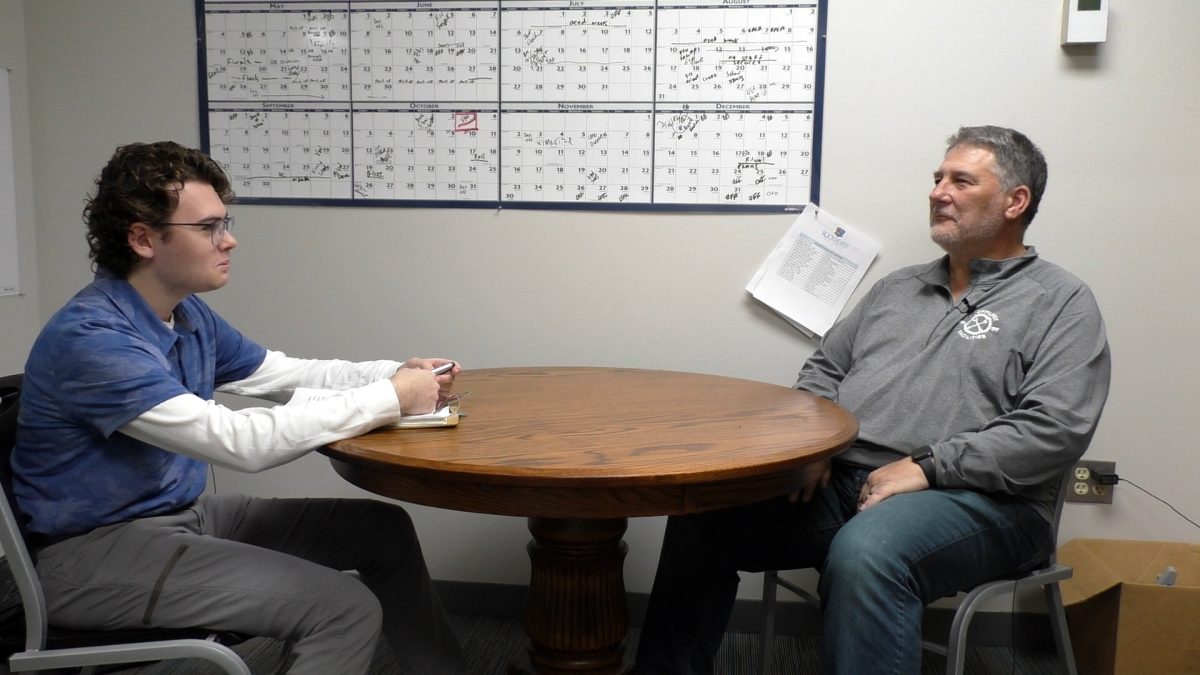
“For our internal professional development committee, the theme of this [year] was ethical use of AI, so we are looking at redrafting a policy to make it a little more robust to give teachers better direction,” Assistant Principal for Academics Mike Wickenhauser said.
Rockhurst’s current approach to AI is to give teachers flexibility. AI and other technology tools are allowed at the discretion of the teachers, who may use them in accordance with their goals for the class. While this policy has the potential to be effective, it is still evolving, with ongoing conversations about how students and teachers should use AI responsibly. Wickenhauser believes Rockhurst should be able to better guide students and teachers as technology becomes more embedded in education.
When AI first began infiltrating education, English classes often felt the impacts earlier than other subjects. For the first time, students could have a computer write an essay entirely for them. This began to cause shifts in the quality and tone of many students’ writing. Teachers started to notice students turning in take-home essays that were much more polished and did not match their usual in-class work.
“Right away I noticed, which is why I returned to in-class writing that could be supervised, because work started to seem unauthentic and didn’t match what I was seeing in class,” English teacher Shawn Schmelzle said.
To the students, returning to in-class writing may have seemed restricting, but teachers did it in an attempt to analyze the voice and writing abilities of each student to help them grow and prepare them for their future classes.
“You don’t shift to paper because you are scared. You shift to paper, because there is value there in achieving the outcomes you are looking for in each student,” Wickenhauser said.
Rockhurst’s response to AI has not been focused on punishment, but on accountability and discussion about the appropriate ways to utilize AI. If a student is suspected of using AI inappropriately, the teachers can use both detection software and their professional judgment to determine whether they have a justifiable reason to assume the use of AI. The teacher will then have a conversation with the student to better understand the situation. If the use of AI is confirmed, there will be a meeting with Wickenhauser and the student’s parents to assess the situation and discuss formal discipline.
Teachers understand it is impossible to catch every time a student uses AI, and they acknowledge that catching students is not their goal or their main priority.
“Broader checks could be in place, but at the same time, I don’t want to put the framework on preventing. I’d rather [focus on] using it appropriately,” Wickenhauser said. “If you spend all your time trying to catch kids, you’re focused on the wrong thing.”
Although the misuse of AI is a real issue in education, the technology has potential positive effects on learning and teaching. Many students and teachers use AI through tools like Grammarly for editing and improving their writing, which is something that is crucial for submitting papers or writing important emails.
“I use AI for editing my work–specifically Grammarly–because it is the most popular tool the students are using, and I wanted to see how it worked,” Schmelzle said. “Now, I use it in my professional communication and my own writing to edit.”
Over the past 25 years, technology has come to play a major role in education. Rockhurst sees AI as a new form of technology that creates opportunities for the future of education while also presenting challenges. The administration hopes to embed AI into its curriculum. The school is also hoping to eventually adopt a licensed AI platform it can use to incorporate into various learning environments.
“If I have an outcome in English where I’m trying to teach you how to revise an essay appropriately and add more detail, AI could be used to help achieve this outcome,” Wickenhauser said.
The main priority for Rockhurst is to continue to teach students how to think critically and come up with their own thoughts and ideas, something that cannot be replaced by AI. As a tool, AI is something that can be used for good, but when it crosses the line of doing the work for the student, most people would admit it has gone too far and violates academic integrity, which is why use of AI has often been connected to potential punishments.
“Currently AI is housed in our discipline section [of the student handbook], and I think that is the wrong lens through which to view it,” Wickenhauser said.
In the math department, the reaction to AI has been similar to that of the English department. The teachers understand that some students are using AI simply to do their work for them, while others are using AI to help them understand certain problems or generate practice questions to help them practice for exams.
“AI is very simple. Some students are gonna use it to copy the answers, and others are going to use AI to learn how to do the problems,” math department chair Joe Leroy said. “So, it’s new, but it’s the same issues as copying their buddies’ work.”
The Rockhurst faculty is hopeful that AI will be an effective and efficient tool in the future in all subjects. AI is likely to become a regular part of education, but doesn’t change the intent.
“The primary responsibility is that you’re still teaching people to think, you’re teaching them how to live virtuously and ethically,” Wickenhauser said.
The administration encourages teachers and students to be open to talking about the topic of AI. They believe the negative view of AI is not a healthy approach to working with the technology.
“Students use it and don’t want to talk about it, and teachers can just always assume students are cheating. We need to end that confrontational relationship,” Wickenhauser said. “The best advice I can give is to try our best as a school to talk and have a relationship with one another, making sure we’re all focused on the same thing.”