
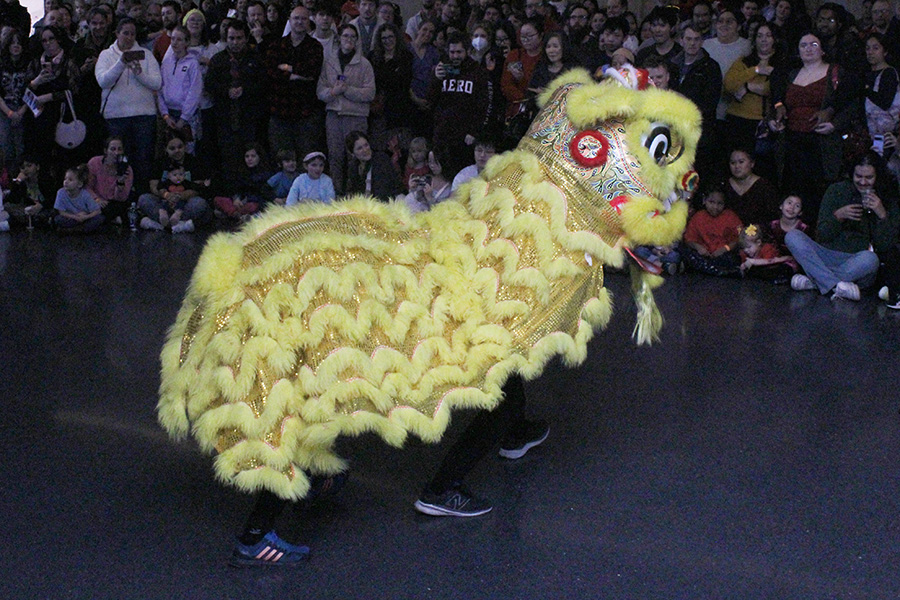
The roll of the drum sounds first, followed by the clanging of cymbals and gongs, eventually synchronizing into a harmony with the pounding drums. Bright colors whirl, and rapid movements usually capture attention first. But behind the Rockhurst Chinese Club’s lion dance performances is something much more symbolic than just spectacle.
Lion dance originated in ancient China as a ritual meant to bring prosperity, good fortune, and drive away evil spirits. Traditionally performed during Chinese Lunar New Year celebrations and important cultural events, the lion costume is considered sacred in Chinese culture—believed to carry power, strength and luck. The drums, gongs, and cymbals that often accompany performances are believed to scare away bad luck and negative energy, while the lion’s movements beckon in prosperity, wisdom and good luck.
Length and spectacle are key. Ancient peoples believed that the longer and more elaborate the dance, the more fortune was bestowed on the people. A long, energetic dance would usher in a prosperous harvest, while a shorter, less enthusiastic dance was believed to foreshadow a difficult period.
“Everything about it revolves around symbolism,” junior dancer Jack Bosco said. “Good luck or bad fortune. The performance is more than a show. A lot of people still believe in its impact on their lives.”
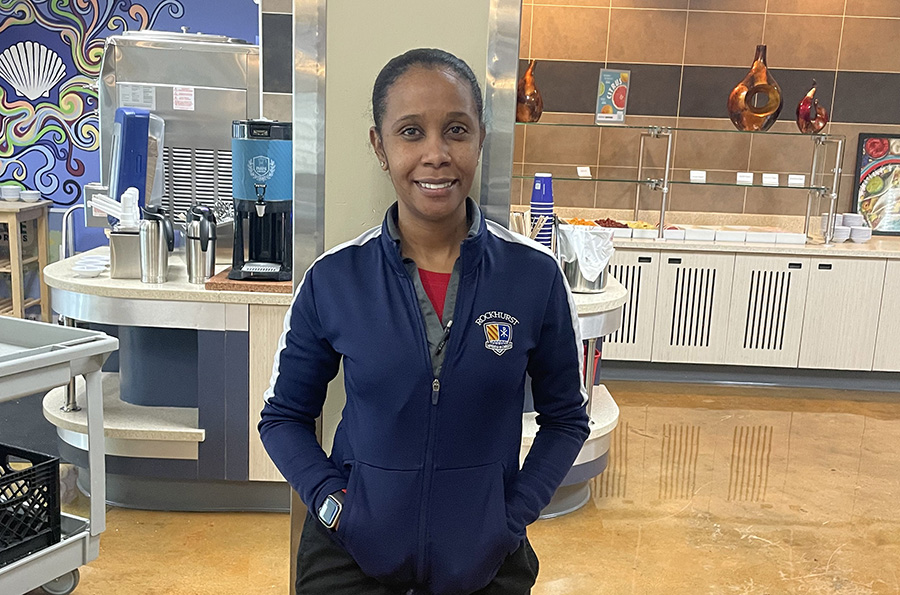
The cultural significance of the lion bringing luck and driving out evil remains strong today, especially as communities work to preserve ancient traditions. Kansas City’s large Chinese-American population has worked in tandem with Rockhurst Mandarin teacher Jackie Shao for the last several years, helping to showcase the lion dance on increasingly larger stages, including the annual Lunar New Year celebration at the Nelson Atkins Museum of Fine Arts, a festival that thousands attend.
According to Shao, for many Chinese-Americans, the lion dance is a way of staying connected to history, heritage, and a way to celebrate their identity through performance. For the Rockhurst lion dance team, the dance serves a similar purpose, though adapted to a modern multicultural audience. Performances are often held at events happening across the city, like cultural celebrations and community gatherings, offering a unique way for the Hawklets to honor the ancient ritual while sharing it with others.
What many people don’t realize is how physically demanding the dance is. Each lion requires two performers, one controlling the head and expression, the other managing the lion’s body language. The dancers must be perfectly coordinated, reacting to the rhythm of the music while simultaneously bringing the lion to life.
Nothing in lion dance is accidental or thrown together. Each action has significance. Each cadence coming from the drum acting together with the symbolism of the lion’s movements. Every blink, every snap of the jaw, every wag of the tail is well thought out.
“It takes a lot of trust—especially when you’re inside the lion with another person,” Bosco said. “You have to move as a unit. If you’re off by just a step, the whole lion looks off.”
Every gesture has meaning. A lion scratching itself shows curiosity. A long charge and bow shows respect. A run and barrel roll represents the driving away of evil spirits. High jumps and sharp H-turns represent strength and fortune. Everything is woven together to form a tapestry of history and culture.
“You see the costume jumping and rolling and think, ‘Oh, that’s kind of cool,'” junior dancer John Kierspel said, “but once you learn a little, you understand the significance behind every move.
“It’s not just performing—it’s storytelling.”
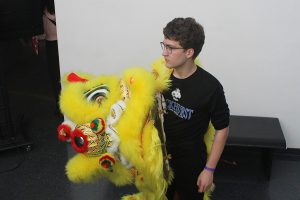
That’s why Rockhurst’s involvement matters. As a school built on the idea of educating the whole person, Shao says it’s important that students engage with cultures beyond their social norms. The Chinese Club and lion and dragon dance team reflect that mission, offering not just a way for students to learn and understand cultural history, but to actively participate in and spread it.
Aside from Shao, two veteran lion dancers have taken the reins in coaching the Hawklets. Eng Ng and Chou Leow have trained and performed the lion dance their entire life, and have provided the Chinese Club with an extra layer of experience and knowledge.
“Lion dance is a performance of the people,” Ng said. “For the people, by the people.”
“This reflects some of the pillars of Rockhurst,” Leow said. “Open to growth, and letting other people be open to growth, in seeing and understanding the lion, and its meaning.”
The lion dance team has performed four times so far this semester, preserving and sharing the cultural significance behind every movement, every beat of the drum, every blink of the eye.
“Lion dance has lasted for centuries, because people have decided to carry it forward,” junior dancer Declan Sullivan said. “Being part of that is something special.”

Maxine Grisolano • Feb 21, 2026 at 11:49 am
This was a very interesting and educational article about the lion and dragon dances. I enjoyed reading it.